Data compression
Students will learn how the information in a pixel can be manipulated to change the image, and apply a bitmask filter to an image to remove some information and reduce the memory size of the file. Finally, students will modify the filter to find a balance between quality and small file size. Based on the original lessons developed by the Exploring Computational Thinking team at Google.
Additional details
| Year band(s) | 7-8, 9-10 |
|---|---|
| Content type | Lesson ideas |
| Format | Web page |
| Core and overarching concepts | Data representation, Computational thinking, Abstraction, Specification (decomposing problems), Algorithms |
| Australian Curriculum Digital Technologies code(s) |
AC9TDI8K04
Explain how and why digital systems represent integers in binary
AC9TDI10K03
Investigate simple data compression techniques |
| Keywords | data representation, abstraction, pattern recognition, data analysis, algorithm design, data, data compression, pixels, pattern, patterns, Google, Google for Education, Education, computational thinking, GoogleCT |
| Organisation | ESA |
| Copyright | Creative Commons Attribution 4.0, unless otherwise indicated. |
Related resources
-

Crack the code - Technology Mandatory
A unit of work that develops knowledge, skills and understanding of coding
-

Emerging technologies
Students follow a problem-solving process to develop an idea for applying emerging technologies to improve existing digital systems.
-

Python language
Students develop and implement digital solutions using Python programming language through applying data types and control structures.
-

Developing user stories
These teacher slides can be used to introduce and develop understandings about user stories and how to write a user story based on a users needs and goals. In this set of slides we use several examples to illustrate the format of a user story.
-

Computational thinking poster
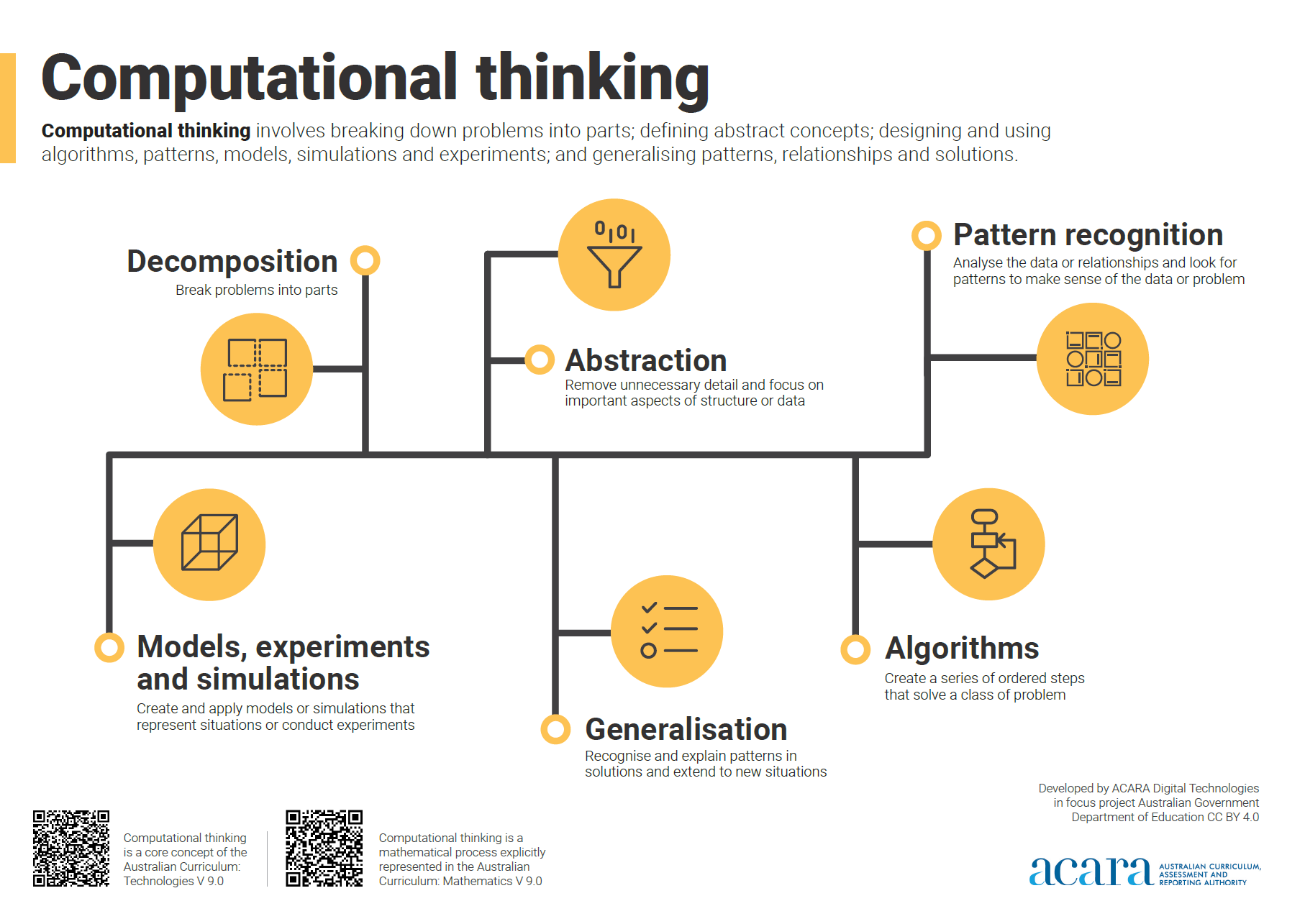
A poster/infographic that gives a brief overview of the concepts related to computational thinking.
-

App Inventor EDU
Use this six week teaching program using a project based curriculum that allows students to explore the world of computer science through the creation of smartphone apps.
-

Classroom ideas: Micro:bit Environmental Measurement (visual and general-purpose programming) (Years 5-8)
Investigating environmental data with Micro:bits: This tutorial shows the coding needed for digital solutions of some environmental issues that can be created using pseudocode and visual programming.
-

Classroom ideas F-10: Aboriginal and Torres Strait Islander connections to Digital Technologies
This resource provides examples of ways Aboriginal and Torres Strait Islander Histories and Cultures can be integrated into Digital Technologies. Examples include 'classification and sorting data' and 'designing solutions'.