Creating a digital start line and finish line with micro:bits (Years 7-8)
The following activity suggests one-way Digital Technologies could be integrated into a unit where vehicles are being designed and produced. Coding examples are provided in three ways: pseudocode, visual programming and general-purpose programming (Python/micro-python).
Additional details
| Year band(s) | 7-8 |
|---|---|
| Content type | Lesson ideas |
| Format | Document |
| Core and overarching concepts | Implementation (programming), Data acquisition, Data interpretation, Specification (decomposing problems), Algorithms, Digital systems, Computational thinking, Impact and interactions, Systems thinking |
| Australian Curriculum Digital Technologies code(s) |
AC9TDI8K02
Investigate how data is transmitted and secured in wired and wireless networks including the internet
AC9TDI8P04
Define and decompose real-world problems with design criteria and by creating user stories
AC9TDI8P09
Implement, modify and debug programs involving control structures and functions in a general-purpose programming language
AC9TDI8P10
Evaluate existing and student solutions against the design criteria, user stories and possible future impact |
| Technologies & Programming Languages | Electronic programming boards |
| Keywords | Algorithms, general-purpose programming language, pseudocode, visual programming, DTIF, DTiF, dtif, ACARA |
| Integrated, cross-curriculum, special needs | Literacy, Digital Literacy |
| Organisation | Australian Government Department of Education and Training |
| Copyright | Australian Government Department of Education and Training, CC BY 4.0 |
Related resources
-

Superhighways used for millennia
In this lesson, students compare physical networks (wired and wireless) to the ancient network related to First Nations Peoples’ trading practices throughout history, including trade routes.
-

Crack the code - Technology Mandatory
A unit of work that develops knowledge, skills and understanding of coding
-

Emerging technologies
Students follow a problem-solving process to develop an idea for applying emerging technologies to improve existing digital systems.
-

Python language
Students develop and implement digital solutions using Python programming language through applying data types and control structures.
-

Developing user stories
These teacher slides can be used to introduce and develop understandings about user stories and how to write a user story based on a users needs and goals. In this set of slides we use several examples to illustrate the format of a user story.
-

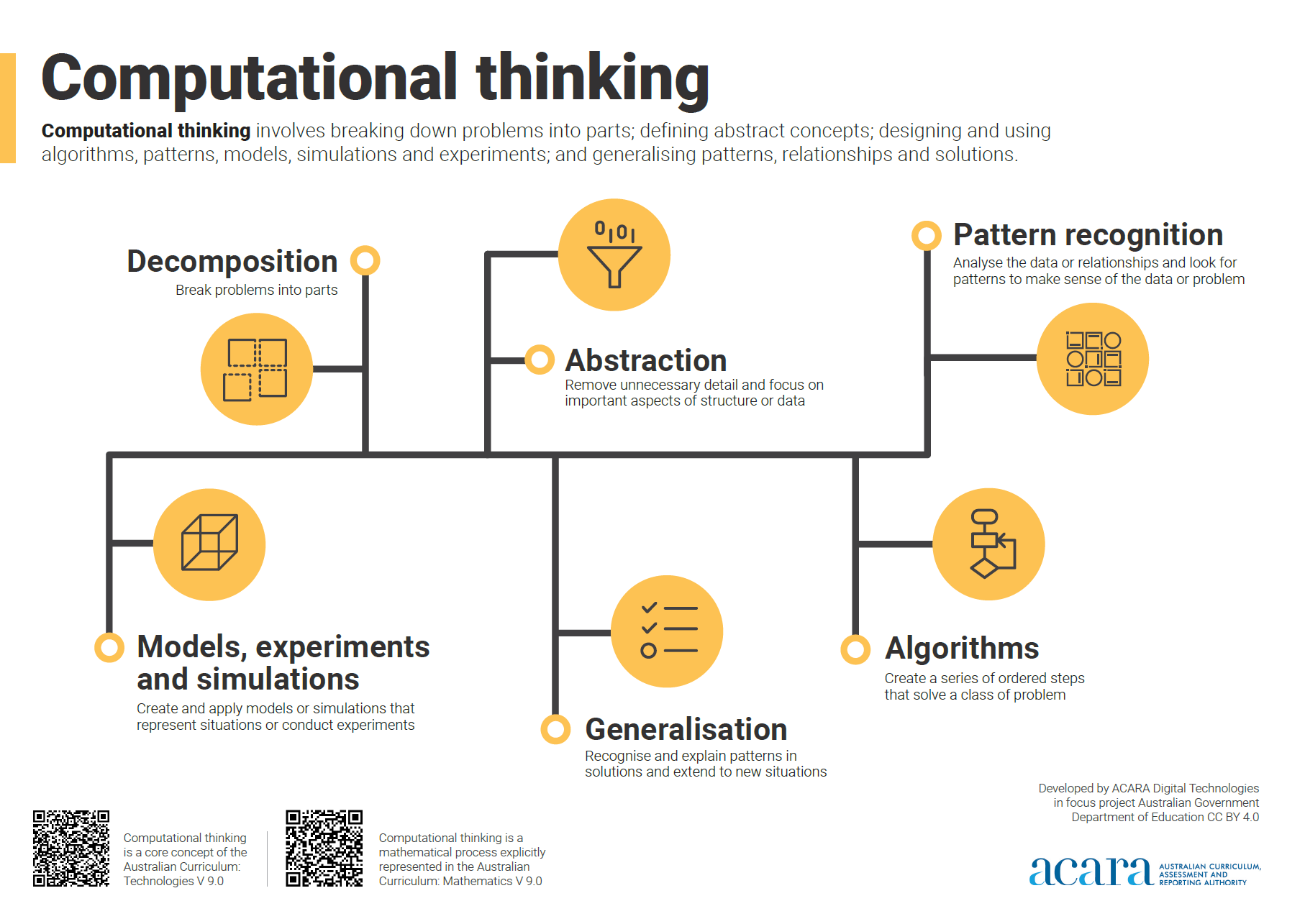
Computational thinking poster
A poster/infographic that gives a brief overview of the concepts related to computational thinking.
-

App Inventor EDU
Use this six week teaching program using a project based curriculum that allows students to explore the world of computer science through the creation of smartphone apps.
-

Classroom ideas: Micro:bit Environmental Measurement (visual and general-purpose programming) (Years 5-8)
Investigating environmental data with Micro:bits: This tutorial shows the coding needed for digital solutions of some environmental issues that can be created using pseudocode and visual programming.